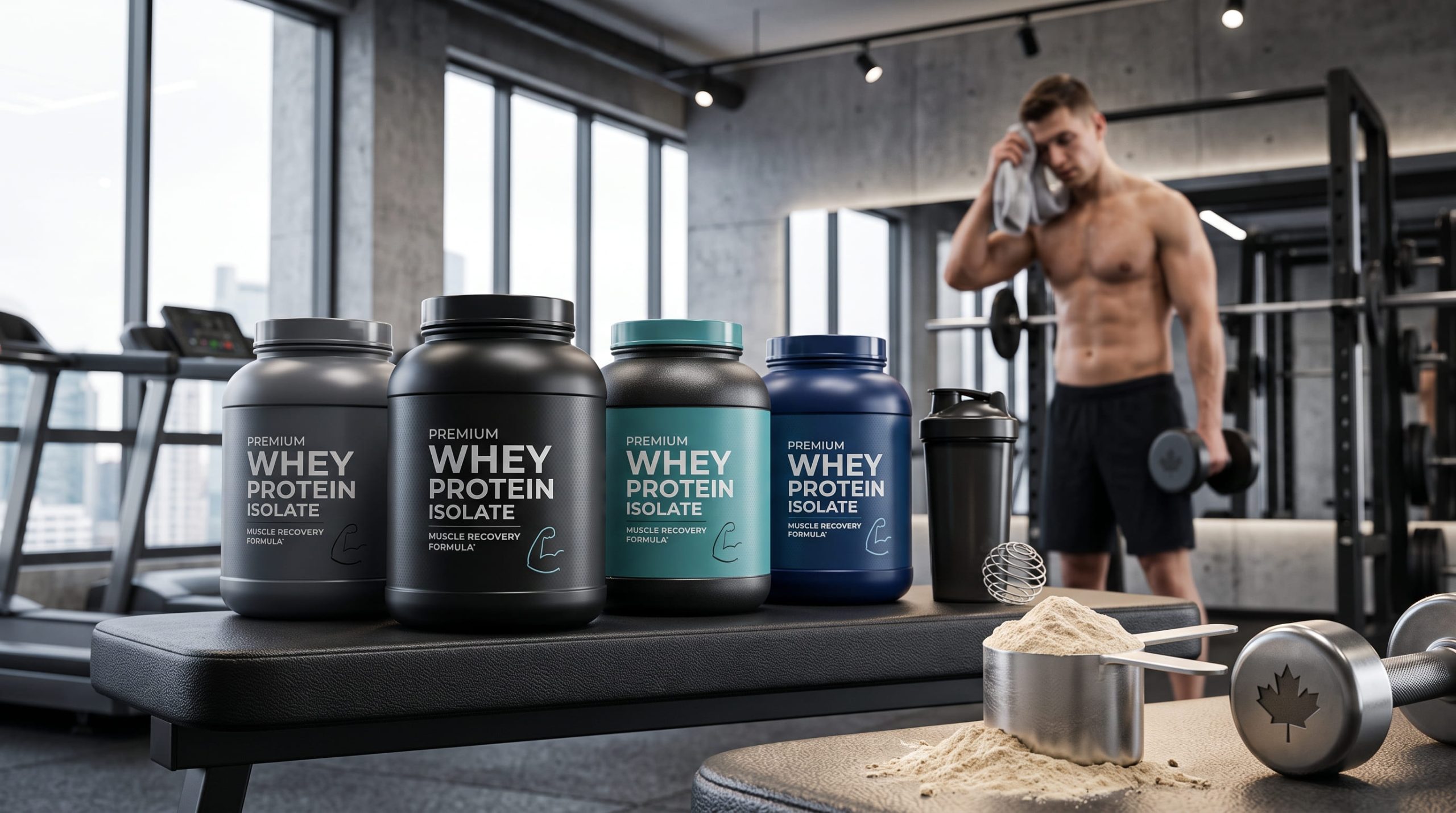
Finding a whey protein powder isn’t difficult in Canada.
Finding one that’s actually worth buying is another story.
Walk through Amazon.ca or a Canadian supplement store and you’ll find everything from inexpensive whey concentrate to premium isolates promising faster absorption, better recovery and cleaner nutrition.
For most lifters, though, the goal is much simpler: get enough high-quality protein to support training without wasting money on marketing.
We’ve compared several popular options based on protein content, protein source, formulation, Canadian availability, third-party testing where available and overall usefulness for different types of lifters.
Our picks for the best whey protein in Canada for muscle gain and recovery include familiar international brands as well as a Canadian option worth considering.
Best Whey Protein in Canada: Quick Picks
| Product | Our Pick For | Protein per Serving |
|---|---|---|
| Optimum Nutrition Gold Standard 100% Whey | Best Overall | 24 g |
| Canadian Protein Whey Protein Concentrate | Best Canadian Value Pick | 24 g |
| ALLMAX Isoflex | Best Premium Isolate | 27 g |
| Dymatize ISO100 | Best Hydrolyzed Whey | 25 g |
| MuscleTech Nitro-Tech Whey Gold | Best Whey Blend | 24 g |
Protein and nutrition values can vary slightly by flavour and formulation. Always check the current product label before purchasing.
How We Chose the Best Whey Protein in Canada
We aren’t ranking protein powders based on which tub has the most aggressive bodybuilding graphics.
There are several things that matter much more.
First is the actual protein source and how much protein you’re getting in each serving.
Then we look at serving size, calories, carbohydrates, sugars, ingredient quality, third-party testing where applicable and whether Canadians can realistically purchase the product without making the process unnecessarily complicated.
Price matters too.
Protein powder is generally something you’ll consume repeatedly. A small difference in price per serving becomes significant when you’re going through several tubs every year.
We also separate whey concentrate, whey isolate and hydrolyzed whey rather than pretending they’re identical products.
Finally, we consider what type of lifter each product makes the most sense for.
The best whey for someone trying to maximize value isn’t necessarily the same protein we’d choose for someone aggressively cutting calories.
1. Optimum Nutrition Gold Standard 100% Whey — Best Overall
Optimum Nutrition Gold Standard has been around long enough that you’ve probably seen the black tub in more than one gym locker room.
There’s a good reason it remains an easy recommendation.
Gold Standard provides 24 grams of protein per serving, with whey protein isolate listed as its primary protein source. Optimum Nutrition also lists approximately 5.5 grams of naturally occurring BCAAs per serving.
For most recreational lifters, this is the balance we’re looking for.
You’re getting a whey formula with a strong protein content without moving completely into premium-isolate pricing.
Another advantage is testing. Gold Standard 100% Whey appears in the Informed Choice certified-products database, and specific certified formulations have been listed for North American availability.
Why We Like It
It isn’t trying to solve a problem that doesn’t exist.
You get a straightforward whey protein that’s easy to use after training, between meals or whenever your normal diet leaves you short on protein.
The wide flavour selection also matters more than people think.
If you’re going to drink something several times every week, buying a protein you actually enjoy is important.
Who Should Buy It?
Gold Standard is our strongest general recommendation for someone who:
- wants one everyday whey protein
- trains primarily for muscle and strength
- doesn’t specifically require a pure isolate
- wants an established product with third-party sport testing
- prefers lots of flavour choices
Possible Downside
It’s not a pure whey isolate.
If minimizing lactose, fat and carbohydrates is your highest priority, an isolate such as ALLMAX Isoflex or Dymatize ISO100 may suit you better.
Chrisima verdict: The easiest all-round recommendation for most Canadian lifters.
2. Canadian Protein Whey Protein Concentrate — Best Canadian Value Pick
There’s also a strong reason to consider buying Canadian.
Canadian Protein manufactures products in Windsor, Ontario and positions its Whey Protein Concentrate as its popular everyday option.
Its current formulation lists approximately 24 grams of protein, 130 calories, 2 grams of fat and 3 grams of sugar per serving, though values can vary between flavours.
The company also states that its products are batch tested and manufactured in Canada.
What makes this interesting isn’t some revolutionary form of protein.
It’s value.
Whey Concentrate Doesn’t Need to Be Fancy
A lot of supplement marketing makes whey concentrate sound like the budget version of “real” protein.
That’s misleading.
Whey concentrate is still a high-quality complete protein.
It simply retains more lactose, carbohydrate and fat than heavily filtered whey isolate.
For someone who digests dairy comfortably and isn’t obsessing over every gram of carbohydrate, concentrate can make a lot of sense.
Who Should Buy It?
Canadian Protein Whey Protein Concentrate is particularly interesting for:
- lifters consuming protein every day
- Canadians who prefer domestically produced supplements
- people prioritizing cost over premium filtration
- bulking or maintenance phases
- anyone who tolerates whey concentrate comfortably
Possible Downside
If lactose bothers you, concentrate may not be your best starting point.
A whey isolate removes more lactose during processing and may be easier for some people to tolerate.
Chrisima verdict: A compelling Canadian option when everyday value matters more than owning the leanest possible formula.
3. ALLMAX Isoflex — Best Premium Whey Isolate
If protein density is your priority, Isoflex gets interesting quickly.
ALLMAX’s Canadian product information lists 27 grams of protein in a roughly 30-gram serving, depending on flavour.
For its chocolate formulation, that serving contains around 120 calories, 2 grams of carbohydrate and 0 grams of sugar. Some flavours differ slightly.
That’s an impressive protein-to-serving ratio.
Unlike powders that mix concentrate and isolate, Isoflex uses whey protein isolate as the protein source.
ALLMAX also states that Isoflex is independently tested for banned substances, and its packet version carries Verified for Sport certification.
Why Would You Choose Isolate?
Further filtration removes more of the lactose, carbohydrate and fat naturally associated with whey.
That makes isolate particularly attractive during a cutting phase when someone wants protein without adding many additional calories.
It’s also commonly preferred by people who tolerate isolate better than whey concentrate.
That doesn’t mean isolate magically builds more muscle.
If you’re already getting enough high-quality protein, simply switching from concentrate to isolate won’t suddenly change your physique.
You’re mainly paying for the nutritional profile and additional processing.
Who Should Buy It?
Isoflex makes sense for:
- lifters cutting calories
- people wanting a very high protein-to-scoop ratio
- those trying to minimize lactose
- competitive athletes concerned about sport testing
- people willing to pay more for a premium isolate
Possible Downside
Price.
Pure isolate generally costs more than basic whey concentrate.
If you digest concentrate perfectly well, you may be spending extra money for nutritional differences that aren’t especially important to your goal.
Chrisima verdict: One of the strongest premium isolate options for Canadian shoppers who care more about macros than getting the lowest possible price.
4. Dymatize ISO100 — Best Hydrolyzed Whey
Dymatize ISO100 takes the filtration idea another step.
Its protein comes from whey protein isolate and includes hydrolyzed whey isolate.
Hydrolysis partially breaks protein down into smaller peptides before you consume it.
Dymatize currently lists 25 grams of protein, no more than 120 calories, up to 1 gram of sugar, 5.5 grams of BCAAs and 2.6 grams of leucine per serving.
The company also states that ISO100 is banned-substance tested.
Does Hydrolyzed Whey Build More Muscle?
This is where you need to separate supplement science from supplement marketing.
Hydrolyzed protein is processed differently, but that doesn’t automatically make it dramatically better for muscle growth than another high-quality whey protein.
Your overall daily protein intake remains much more important.
The International Society of Sports Nutrition notes that rapidly digested proteins containing essential amino acids and adequate leucine effectively stimulate muscle protein synthesis, while total daily protein intake remains central for exercising individuals.
ISO100 therefore makes the most sense for someone who specifically wants a lean, highly processed whey isolate rather than someone simply looking for “the strongest protein.”
Who Should Buy It?
Consider ISO100 if you:
- want hydrolyzed whey isolate
- prefer minimal sugar and carbohydrate
- are dieting
- want a lighter protein formula
- prioritize digestibility
Possible Downside
You’re entering premium protein territory again.
Someone simply trying to add 25 grams of protein to breakfast probably doesn’t need to pay extra for hydrolysis.
Chrisima verdict: An excellent premium option, but its advantages are more relevant to demanding buyers than beginners simply trying to hit their protein target.
5. MuscleTech Nitro-Tech Whey Gold — Best Whey Blend
Not everybody needs pure isolate.
Nitro-Tech Whey Gold takes a blended approach, combining whey protein concentrate, whey protein isolate and hydrolyzed whey protein.
The current formula provides 24 grams of protein in a 34-gram serving, with approximately 130 calories, 3 grams of carbohydrate and 2 grams of sugar for Double Rich Chocolate.
MuscleTech also lists approximately 5.4 grams of naturally occurring BCAAs for the product.
Why Use Several Types of Whey?
Blending protein sources can allow manufacturers to balance cost, taste, texture and nutritional characteristics.
A blend isn’t automatically worse than pure isolate.
What matters is what you’re actually getting per serving and how the product fits your goal.
For someone who wants a traditional creamy whey shake rather than an ultra-lean isolate, a blend can be perfectly sensible.
Who Should Buy It?
Nitro-Tech Whey Gold is worth considering for:
- everyday gym users
- people who enjoy traditional whey shakes
- muscle-building or maintenance phases
- buyers who don’t need pure isolate
- people wanting a combination of concentrate, isolate and hydrolyzed whey
Possible Downside
People specifically looking to minimize lactose or carbohydrates should probably look at the isolate options first.
Chrisima verdict: A practical blended whey formula for people who care about overall performance and taste more than having “100% isolate” printed on the tub.
Comparing the Best Whey Protein for Muscle Gain and Recovery
Picking a winner becomes much easier once you know what you’re actually trying to accomplish.
Best for Most People
Optimum Nutrition Gold Standard 100% Whey
It gives us the best overall combination of protein, versatility, testing and mainstream availability.
Best for Value
Canadian Protein Whey Protein Concentrate
A straightforward Canadian-made concentrate that makes sense when you use protein frequently and cost matters.
Best for Cutting
ALLMAX Isoflex
Its protein density and low carbohydrate and sugar content make it particularly attractive when calories are being tightly controlled.
Best Hydrolyzed Option
Dymatize ISO100
A strong choice when you specifically want whey isolate with hydrolyzed protein.
Best Whey Blend
MuscleTech Nitro-Tech Whey Gold
An approachable blend for lifters who don’t need a pure isolate.
Does Whey Protein Actually Help Build Muscle?
Whey protein doesn’t build muscle simply because you drink it.
Resistance training creates the stimulus.
Protein provides amino acids your body can use to repair and build tissue.
When those two things are combined consistently, protein supplementation can be useful.
The International Society of Sports Nutrition recommends approximately 1.4–2.0 grams of protein per kilogram of body weight per day for most exercising individuals, while noting that needs can vary depending on circumstances.
The same position stand notes that around 20–40 grams of high-quality protein per feeding is a reasonable general recommendation for stimulating muscle protein synthesis, depending on factors including body size, age and training.
For an 80-kilogram lifter, 1.4–2.0 g/kg works out to roughly 112–160 grams of protein per day.
A scoop of whey containing 24–27 grams can therefore make hitting that total considerably easier.
But it’s still only part of the day’s diet.
Whey Protein Concentrate vs Whey Isolate
This is probably the biggest decision you’ll make when shopping.
Whey Concentrate
Concentrate undergoes less filtration.
It normally retains more:
- lactose
- fat
- carbohydrate
It also tends to cost less.
For many lifters, that’s completely fine.
Whey Isolate
Isolate undergoes additional processing to remove more non-protein components.
That generally means:
- more protein relative to serving weight
- less lactose
- less carbohydrate
- less fat
If you’re cutting or sensitive to lactose, isolate may justify the additional cost.
If you’re bulking and digest regular whey comfortably, concentrate can provide excellent value.
For a deeper comparison, see our main Best Protein Supplements in Canada for Muscle Gain guide.
How Much Whey Protein Should You Take?
Don’t start by asking how many scoops you need.
Start by asking how much protein you’re already getting from food.
Suppose your daily target is 140 grams.
If your normal meals provide 120 grams, one whey shake containing roughly 20–25 grams solves the problem.
If you’re already eating 150 grams from whole foods, adding three shakes because somebody on TikTok told you to isn’t necessarily useful.
Protein powder should fill a nutritional gap.
It shouldn’t create one.
When Is the Best Time to Take Whey Protein?
The post-workout shake became almost sacred in bodybuilding culture.
There is some logic behind taking protein around training, but the window isn’t a 15-minute emergency.
The ISSN notes that consuming protein before or after resistance exercise can support muscle protein synthesis and that the anabolic effects of exercise remain elevated well beyond the immediate end of a workout.
For practical purposes, whey works well:
- after resistance training
- as part of breakfast
- between meals
- when travelling
- whenever you’re behind on your protein target
Consistency matters more than racing toward your shaker bottle after your final rep.
Is Whey Protein Good for Recovery?
Protein supports the repair and maintenance of body tissues.
After resistance training, muscle protein breakdown and synthesis are both affected by the training stimulus.
Providing adequate protein gives your body the amino acids needed to support the rebuilding process.
This is why the best whey protein in Canada for muscle gain and recovery isn’t necessarily the protein with the fastest marketing claim.
It’s the one that helps you consistently meet your nutritional requirements alongside appropriate training, calories and sleep.
What Should Canadians Check Before Buying Whey Protein?
Canadian shoppers should look beyond the front label.
Protein per Serving
Around 20–30 grams per serving is common among the products on this list.
Compare that number with the total scoop size.
Protein Source
Look for terms such as:
whey protein concentrate
whey protein isolate
hydrolyzed whey protein
They tell you much more than a proprietary marketing name.
Cost Per Serving
This is far more useful than comparing tub prices.
A $90 tub with 60 servings may be better value than a $65 tub containing 25.
Sugar and Calories
These become more important when cutting.
During a bulk, the difference may be much less meaningful.
Lactose
Whey comes from milk.
People who have difficulty with whey concentrate may sometimes tolerate isolate better because additional processing removes more lactose.
That doesn’t make isolate lactose-free unless the manufacturer specifically establishes that.
Sport Certification
Competitive athletes should pay particular attention to third-party certification and banned-substance testing.
Programs such as Informed Choice maintain databases of independently tested sports-nutrition products.
A Note About Protein Supplements in Canada
Canadian supplement regulation can get confusing because protein products aren’t all classified exactly the same way.
Health Canada explains that some protein dry mixes are treated as foods, while products marketed as workout supplements with specific directions of use can fall under Natural Health Product regulations.
That’s why we don’t simply tell readers that every protein powder must have an NPN.
The classification depends on the individual product and how it is formulated and represented.
When a supplement is regulated as a Natural Health Product, consumers can verify licensed products through Health Canada’s database.
Do You Need Whey Protein to Build Muscle?
Absolutely not.
You can get protein from:
- chicken
- beef
- fish
- eggs
- milk
- Greek yogurt
- cottage cheese
- legumes
- tofu
- other whole foods
Whey is useful because it’s convenient.
That’s the real selling point.
You can put roughly 25 grams of protein into a shaker and consume it in minutes.
For busy people trying to consistently eat enough protein, that convenience has real value.
Our Final Pick
If we had to recommend one whey protein for the average Canadian lifter, we’d start with Optimum Nutrition Gold Standard 100% Whey.
It provides 24 grams of protein, uses whey isolate as its primary protein source, has a long-established presence in sports nutrition and has certified formulations listed by Informed Choice.
But there isn’t one answer for everyone.
For value-conscious Canadian shoppers, Canadian Protein Whey Protein Concentrate deserves consideration.
For someone cutting who wants a highly concentrated isolate, ALLMAX Isoflex stands out.
For those specifically looking for hydrolyzed isolate, Dymatize ISO100 makes more sense.
And if you want a traditional multi-source whey formula, MuscleTech Nitro-Tech Whey Gold remains a solid option.
The best whey protein in Canada for muscle gain and recovery is ultimately the product that fits your protein target, digestion, budget and training routine well enough that you can use it consistently.
Frequently Asked Questions
What is the best whey protein in Canada for muscle gain?
For most lifters, Optimum Nutrition Gold Standard 100% Whey is a strong all-round choice because it combines 24 grams of protein with a whey formula led by whey isolate. Other products may be more suitable when price, lactose or calorie intake is the priority.
Is whey concentrate or isolate better for muscle gain?
Both provide high-quality protein. Isolate contains a higher percentage of protein and generally less lactose, fat and carbohydrate, but whey concentrate can build muscle perfectly well when your overall diet supplies enough protein.
Is whey protein good after a workout?
Yes. Whey is a rapidly digested complete protein and provides essential amino acids following resistance training. However, your total daily protein intake remains more important than consuming a shake at an exact minute.
How much whey protein should I take per day?
Use whey to fill the gap between the amount of protein you get from food and your overall daily protein target. There is no universal number of scoops everybody needs.
Can I drink whey protein every day?
Many healthy active adults use whey as part of their normal protein intake. Follow the product directions and account for protein from your entire diet. Anyone with relevant medical conditions, allergies or other health concerns should discuss supplementation with an appropriate healthcare professional.
Is expensive whey protein always better?
No. Higher prices may reflect isolate processing, certification, flavouring, branding or packaging. Compare protein per serving, ingredient source, serving count and cost per serving rather than assuming a more expensive tub will produce better results.